The factory worker. The hospital bed. The last convoy of fuel. In UNTIL PEACE, they are all part of the same decision.
Lead a contemporary country through invasion, one week at a time. Balance civilian survival with military readiness, build capabilities and work towards a military or negotiated end to the conflict.
This guide explains the current national campaign rules. Start with the guided first week, or keep the rulebook beside you while you play.
Open a playable national campaign and select the main map view. Close any dialog or tooltip. Use a framing that shows the whole country and the current incursion.
Suggested filename
01-territory.png
Framing
Landscape, ideally 1920 × 1080 or larger. Keep the full game window and readable English UI.
SCREEN 02
Population & care
Understand the people behind every assignment.
Show available workers, civilian assignments and population or care indicators. Keep the selected Population page and its controls visible.
Open Population. Choose a view where workforce assignments and the population forecast can be read together. Do not cover the panel with a dialog.
Suggested filename
02-population.png
Framing
Landscape, ideally 1920 × 1080 or larger. Keep the full game window and readable English UI.
SCREEN 03
The resource balance
Compare production, consumption and the stock left over.
Show Economy → Summary with food, electricity, equipment, fuel, weapon kits and treasury cards. Include production, consumption and closing-stock values where visible.
Open Defense, then Readiness. Keep the force comparison and the readiness indicators visible. Use the same campaign and week as the economy capture if possible.
Suggested filename
04-readiness.png
Framing
Landscape, ideally 1920 × 1080 or larger. Keep the full game window and readable English UI.
SCREEN 05
Defence or attack
See what a stronger commitment asks of the country.
Show Defense → Strategies with the five-position posture control and its selected posture. Include the visible costs or forecast comparison.
Open Defense, then Strategies. Leave the current posture as it is; no need to commit an attack or advance time. Capture the selector and its explanation clearly.
Suggested filename
05-strategies.png
Framing
Landscape, ideally 1920 × 1080 or larger. Keep the full game window and readable English UI.
SCREEN 06
The strategic plan
Build the capabilities your country needs next.
Show the Plan tree and a selected capability with its name, prerequisites, planning-point cost and effect.
↳ Territory lost reduces the resources available to the whole system. ↵
START HERE / GUIDED CHECKLIST
Your first week in command.
No perfect opening. Just seven deliberate checks before you move the clock forward.
FIELD EXERCISE 01ILLUSTRATIVE DATA
Read the deficit. Not just the stock.
A simplified food ledger. These numbers teach the calculation; they are not a campaign forecast.
Opening stock100 units
Weekly production+80
Weekly consumption−100
Closing stock80
W180
W260
W340
W420
W50
The reserve buys five weeks. It does not fix the deficit.
0 of 7 checks complete
Checklist progress is saved in this browser when available.
LEARN BY DECIDING / THREE FIELD EXERCISES
Before you commit, make the connection.
Short, illustrative situations. Pick an answer and read the reasoning. These exercises teach judgement, not a guaranteed winning strategy.
WHAT WOULD YOU CHECK FIRST?
THE RULEBOOK / KEEP IT BESIDE YOU
The rules behind the decisions.
All 12 chapters
CHAPTER 01 / 12
Chapter 01 / Your objective
The country comes first
Keep the country viable while building a route to an end of the war.
UNTIL PEACE is a contemporary national crisis strategy game set in 2026. You manage the people, production and decisions that keep a country alive under invasion. The battlefield and the home front draw on the same resources.
Your task is to preserve the population, sustain the defence and find an end to the war. Liberation, enemy withdrawal and a negotiated ceasefire are different outcomes. Surviving one more week is useful only if it leaves you a viable next week.
Chapter 02 / The weekly cycle
One week. Many consequences.
Prepare freely in time, but read immediate costs. End Week resolves the consequences.
Read the situation. Check the front, public support, population, stocks and the next enemy threat.
Prepare the country. Adjust civilian jobs, military staffing, production, laws and strategic plans.
Resolve the dispatch when one is offered. Read each option and its costs before choosing. The desktop opening week has no dispatch; dispatches begin in week 2.
Review the forecast. Recheck supply coverage, closing stocks, military readiness and expected territorial change after your adjustments.
Choose End Week. Confirm to resolve production, consumption, fighting, casualties and other weekly consequences.
Read the report. Compare the result with your expectations and prepare the next week.
Changing a plan does not itself resolve a week. Some decisions spend resources immediately, however: preparation is not a free trial for every action. Read the confirmation before committing.
Chapter 03 / Population & assignments
One national workforce
Every assignment draws from the same national pool.
You manage a shared national workforce, not separate playable regions. Use the available-worker pool to staff production and services. Returning people from a civilian job releases them for another assignment.
Food, electricity, equipment, care and housing compete for workers. Recruiting soldiers strengthens the army only if the remaining workforce can feed, equip and sustain it. Injuries and deaths reduce what the country can do; patients do not instantly become available workers.
Care is a service capacity, not a stockpile. Housing is accessible capacity: enough buildings on paper do not help when occupation makes them unavailable. Construction and civilian maintenance must be considered alongside production.
Chapter 04 / Economy & resources
Keep the supply chains connected
A stockpile delays a shortage. A sustainable flow prevents it.
Population and military needs; shortages damage survival and readiness.
Electricity
National demand and the extra electricity used by fuel refining.
Equipment
Competing civilian and military uses, including weapon-kit conversion.
Fuel
Civilian distribution and army mobility; attacking raises military consumption.
Weapon kits
Equipment coverage of deployed soldiers; aggressive postures need more kits per combatant.
Care
Service coverage and patients awaiting recovery, rather than stored inventory.
Housing
Accessible homes, maintenance, construction and displacement.
In Economy, open a resource to inspect production, consumption, stocks and conversions. Fuel refining uses electricity. Weapon-kit production uses equipment. Increasing a conversion can solve one shortage while creating another.
For stored resources, read the expected closing stock, not just current inventory. Stocks can cover a production deficit temporarily. In the current build, weapon-kit stockpiling is unrestricted; production still requires equipment.
Chapter 05 / Territory & cities
A retreat reaches far beyond the front
Losing ground also means losing productive capacity, housing and supplies.
The front starts at the real border near the campaign’s entry point. Its initial width depends on committed enemy forces and the available border. It expands as the invasion progresses; it is not a uniform band across every country.
Occupation reduces accessible productive capacity and housing. A new territorial loss also captures part of your stocks. Retaking ground does not automatically return the supplies already captured.
100%Free city output
50%Threatened city output
0%Occupied city output
These percentages describe the city-output factor. Total national production also depends on workforce, support, shortages and other modifiers. City status and the visible front use the same geographic model.
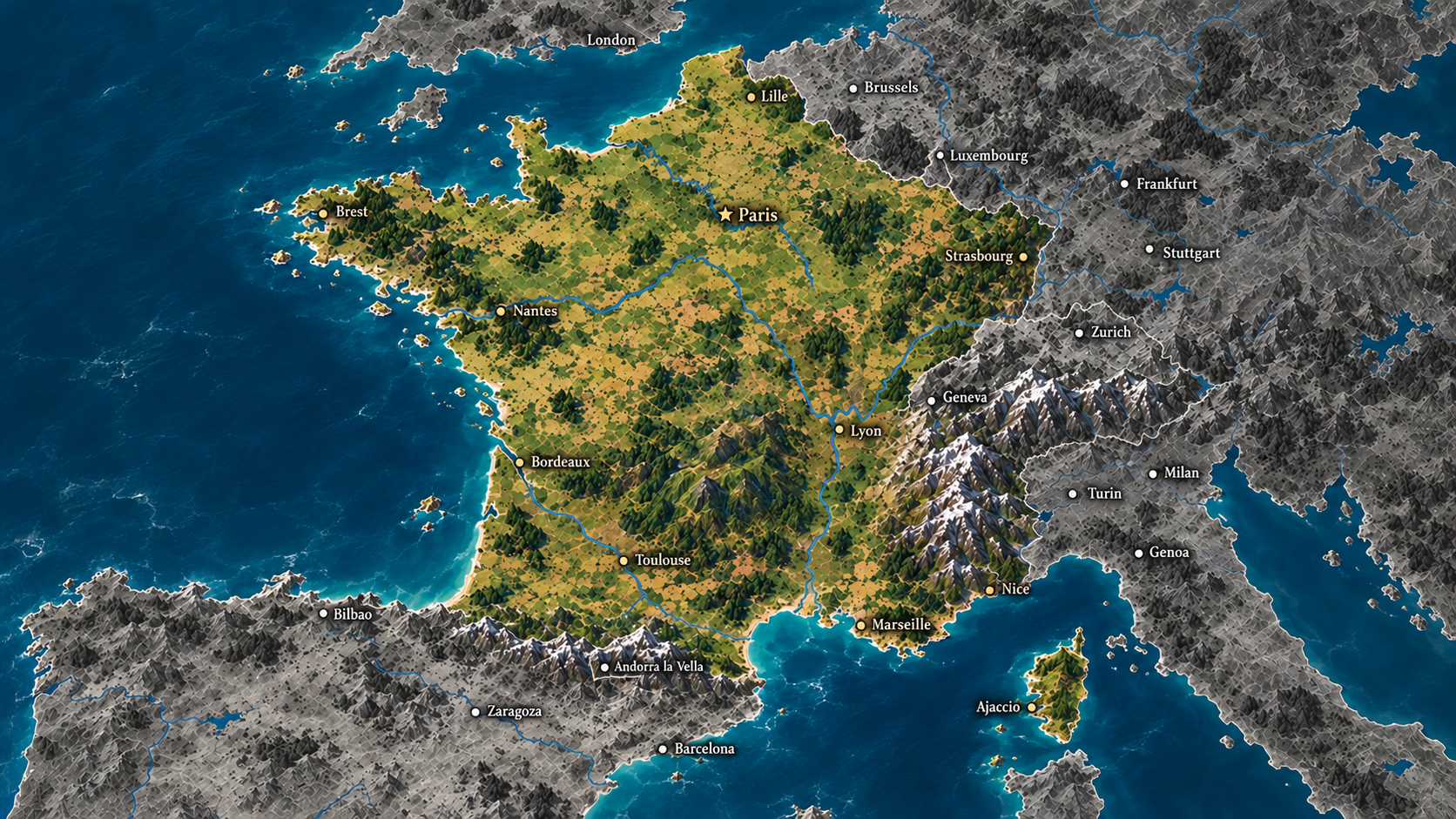
Approved France Atlas artwork. The game adds interactive cities and front overlays; this is the underlying map, not a gameplay screenshot.
Chapter 06 / Army & rotation
Readiness is more than headcount
Count effective fighting power, not just uniforms.
Combat personnel defend the line and take battlefield casualties. Resting personnel remain in the military and still require upkeep, but do not contribute to deployed combat strength. Rest helps manage operational fatigue.
In the current operational rules, combat and resting groups track their own fatigue. Exchanging equal numbers between the groups rotates units; simply recruiting fresh personnel is not an instant reset of the army’s exhaustion.
Effective force depends on personnel, supply, weapon kits, fuel, fatigue and other national or strategic modifiers. Compare effective strength with enemy pressure rather than comparing troop counts alone.
Modern fatigue bands
Fatigue
Force multiplier
0–19
×1.10
20–49
×1.00
50–64
×0.90
65–84
×0.75
85–100
×0.60
Chapter 07 / Defence & attack
Choose the commitment you can sustain
A higher commitment demands more supply and exposes more people.
Open Defense → Strategies to choose among five persistent postures. The first visit selects Balanced; later visits retain your choice. Defensive postures do not initiate reconquest. An attack setting increases costs and exposure; it does not guarantee a gain.
Strong defenceIntensive attack
Rule comparison only. This control does not change your game.
Multipliers relative to Balanced
Posture
Force
Equipment demand
Military fuel
Kits / combatant
Casualties
Combat fatigue
Strong defence
1.20
0.85
0.85
1
0.70
0.70
Defence
1.10
0.92
0.92
1
0.85
0.85
Balanced
1.00
1.00
1.00
1
1.00
1.00
Attack
0.95
1.20
1.25
1.5
1.25
1.30
Intensive attack
0.90
1.40
1.50
2
1.60
1.60
Under the current posture rules, reconquest requires an attacking posture, a held line, a force ratio of at least 120% and military supply support of at least 95%. This supply-support measure is distinct from public support. An insufficient force can still lose territory while attacking.
Base weekly gains are 0.3 percentage points for Attack and 0.6 for Intensive attack, scaled by advantage from ×0.5 to ×2 and limited by occupied territory. These are current prototype balance values and may change. Moving the slider does not itself consume existing kits; battle losses still apply.
Chapter 08 / Public support & laws
Protect the will to continue
Public support is a resource you cannot afford to ignore.
Public support is a national measure from 0 to 100. It influences productivity and morale. Casualties, shortages, territorial losses and burdensome policies can erode it. Inspect the support page to identify the largest recent negative cause.
Warnings begin at 50; below 30 the situation is critical and strike penalties grow. In new recovery-rule campaigns, government collapse follows two consecutive resolved weeks at support 5 or below. Recovering above 5 resets that counter. Losing the capital remains decisive independently.
Laws are persistent choices with benefits and costs. Revisit them as the emergency changes. In the recovery revision, industrial overtime costs 0.40 support per week, vehicle requisition 0.25 and war tax 0.35. Other laws have their own restrictions and effects shown in the game.
A support crisis can unlock at most two emergency deliveries, each covering 25% of one week’s needs for the most undersupplied eligible essential resource: food, electricity or fuel. They wait for a real shortage and are not a sustainable production plan.
Chapter 09 / Treasury, trade & aid
Pay for today without losing tomorrow
Cash solves a payment problem; it does not remove a production problem.
The treasury funds imports and other national costs. Military upkeep, war costs and debt obligations compete with tax income and international help. Inflation can reduce productivity, so additional cash is not free capacity.
Trade orders have a price, a quantity and a delivery date. An incoming shipment is not current stock: check whether it arrives before the shortage. Selling a surplus creates cash but reduces your reserve for later weeks.
War bonds raise cash and create a repayment commitment. Printing money raises cash and inflation. Read the treasury forecast before adding another obligation.
International aid depends on diplomatic progress and the war situation. Agreements can supply resources or support the economy. Treat the amounts shown in the resource pages as part of your plan; do not assume an uncompleted diplomatic plan already provides aid.
Chapter 10 / Plans & intelligence
Invest in the weeks ahead
Invest in the capability your country will actually need.
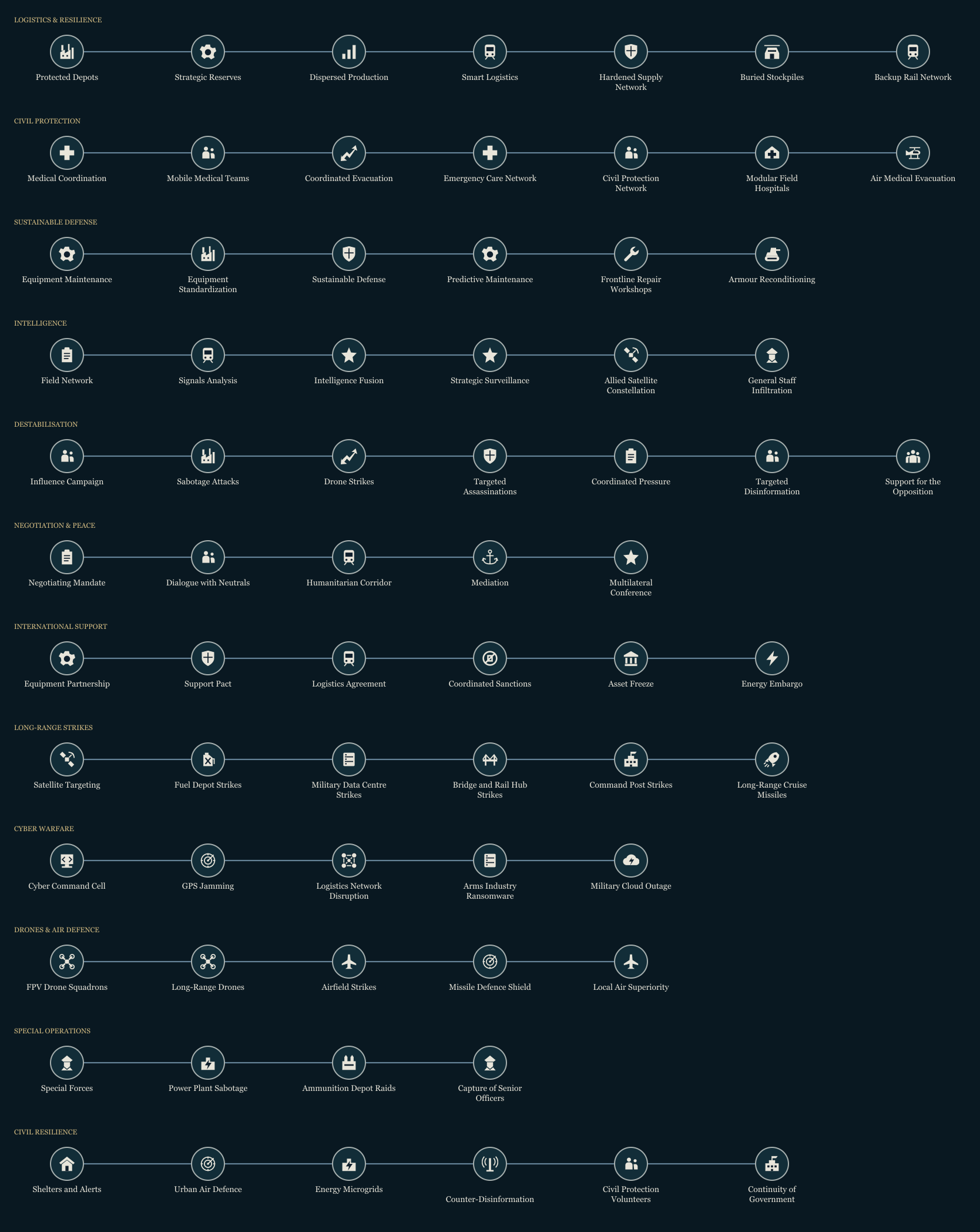
The Plan tree develops capabilities across logistics, civilian protection, sustainable defence, intelligence, diplomacy and other branches. Read a plan’s prerequisites, planning-point price and resource costs before purchasing it. Current war campaigns gain planning points as weeks advance.
Choose capabilities that address a real bottleneck. Logistics is useful when supply is vulnerable; civilian protection matters when population losses are mounting; diplomacy needs time before it can produce a settlement. Purchasing agreements activates their associated effects under the current rules.
Intelligence improves your understanding of the enemy. Estimates remain uncertain. A forecast of a held line or a successful attack is not a promise; actual weekly resolution determines the result.
Project plan-tree overview, 16 October 2026. Reference illustration, not a capture of the current interactive interface. Open to inspect the full image.
Chapter 11 / Peace & campaign outcomes
An ending is a decision, too
Read the final terms, not just the word “peace”.
Diplomacy offers a route out of the war without liberating every occupied city. For new recovery-rule campaigns, Mediation or the corresponding multilateral capability and 12 completed weeks open talks. A settlement is possible after 18 completed weeks, subject to its conditions and with no active tactical order.
Favourable peace
At most 40% occupation, a held line in the previous week, and sufficiently low enemy will. The normal will limit is 60; 70 requires the relevant diplomatic capability, at least two support agreements and established negotiating leverage. This route does not add a territorial concession.
Concession armistice
At most 75% occupation, plus either at least 15% already occupied or 26 completed weeks. You also need two held weeks in the last three, or public support below 30. Enemy will does not block this route. Acceptance concedes an additional five percentage points of national territory.
Both routes require explicit acceptance. Review retained and conceded territory in the offer before confirming. Refusing does not advance time.
Other endings
Liberation: recovering all occupied territory through actual gains is a defensive victory, not automatic unconditional enemy surrender.
Enemy withdrawal: a separate military outcome when the campaign’s withdrawal conditions are met.
Defeat: capital loss or government collapse can end resistance.
Stalemate: an unresolved recovery-rule campaign is reviewed after 52 resolved weeks and ends in a draw. This is not automatic peace or victory; decisive endings take precedence.
Chapter 12 / Troubleshooting & glossary
When the plan stops working
Find the failed link before adding more resources.
Why is my bigger army weaker?
Look for missing weapon kits, low military supply coverage, fuel shortages, fatigue or workers removed from essential production. Headcount alone is not effective force.
Why am I not retaking territory?
Defensive postures never initiate reconquest. In an attacking posture, verify the held-line condition, force ratio and military supply support. More aggressive settings can lower effective force and worsen shortages.
Why do I have stocks but a warning?
Production may be lower than consumption. Stocks are a temporary buffer; the warning considers the net deficit. Care and housing instead need sufficient capacity.
Why did the outcome differ from the forecast?
Enemy intelligence is an estimate. Longer projections assume current assignments and cannot know future dispatches. Use forecasts to compare choices, then read the actual report.
Can I use this guide with an old save?
The broad economic principles still apply, but old saves may retain earlier balance rules and tactical orders. Use the costs, conditions and ending information shown by that save. This guide describes the current new-campaign experience.
Coverage
Available supply or capacity relative to demand.
Closing stock
Inventory expected after the coming week’s flows and losses.
Force ratio
Effective defending force divided by enemy pressure; 120% means 1.2 times that pressure.
Public support
The population’s willingness to sustain the war, on a 0–100 scale.
Military supply support
A readiness factor derived from essential supply and care coverage; distinct from public support.
Percentage point
An absolute change in a percentage: from 20% occupation to 25% is five percentage points.
No matching chapters. Try a resource name or clear the search.